Students
Campus hubs and MSAs — so a student arriving alone finds the people already there.
Live, in production · kawthar.app
Kawthar takes its name from the abundant good granted to the ummah of our beloved Prophet ﷺ. That good is already here — in teachers, mosques, markets and neighbours. Kawthar's whole job is to help you reach it: one place for every community need, and a navigator that carries you to the people behind it.
الكوثر
al-Kawthar · “the abundance”
The name
Most platforms begin from scarcity: something is missing, and the product will supply it. Kawthar begins from the opposite claim — that the good has already been given, and is already present in the community.
So the product is not the destination. A person arrives for one need — a prayer time, a class, a mosque, a business, a question — and leaves pointed at a human being who can actually help.
The platform surfaces and routes. Humans judge.
All its forms
Community isn't one thing. It's the campus you study on, the masjid you pray in, the shops you keep in business, and the city you have a say in. Kawthar is built to serve each of them and to move people between them.
Campus hubs and MSAs — so a student arriving alone finds the people already there.
Prayer times, iqama and jumu'ah for real masjids nearby — the daily reason to open it.
A marketplace for community businesses — commerce, never a cut of anyone's soul.
Know who represents you, and what the community's own organisations are saying.
What shapes it
Kawthar has a written constitution its builders obey. Most of it is about what the product will never do — which is the part that decides what it becomes.
Reading shouldn't require an account. Prayer times, masjids, classes and directories are there for whoever arrives, and verification is asked for when you post, RSVP, claim or host. Where safety calls for it — detail that could be used to target the community — a sign-in may sit in front of it. Open is the default, not an absolute; protecting people comes first.
No percentage of a scholar's booking. No cut taken because two people found each other. Some parts cost real money to run — the marriage service especially — so they may carry a flat one-time fee, and members may be asked for one to help carry the infrastructure. Flat, stated up front, and never a share of what someone was helped to find.
Kawthar issues no trust scores and no “verified scholar” badge. Institutions and chains are shown plainly, every endorsement belongs to a named organisation, and the seeker judges.
No infinite scroll, no autoplay for dwell time, no follower counts on scholars. Success is measured in people connected, not minutes captured.
No dead ends. Every surface routes somewhere real — because the goal was never the app. It's the gathering the app points at.
On screen
The home screen is a launcher: the apps a person actually needs, what's happening nearby, the next salah, and the masjids closest to them — reachable before signing in to anything.
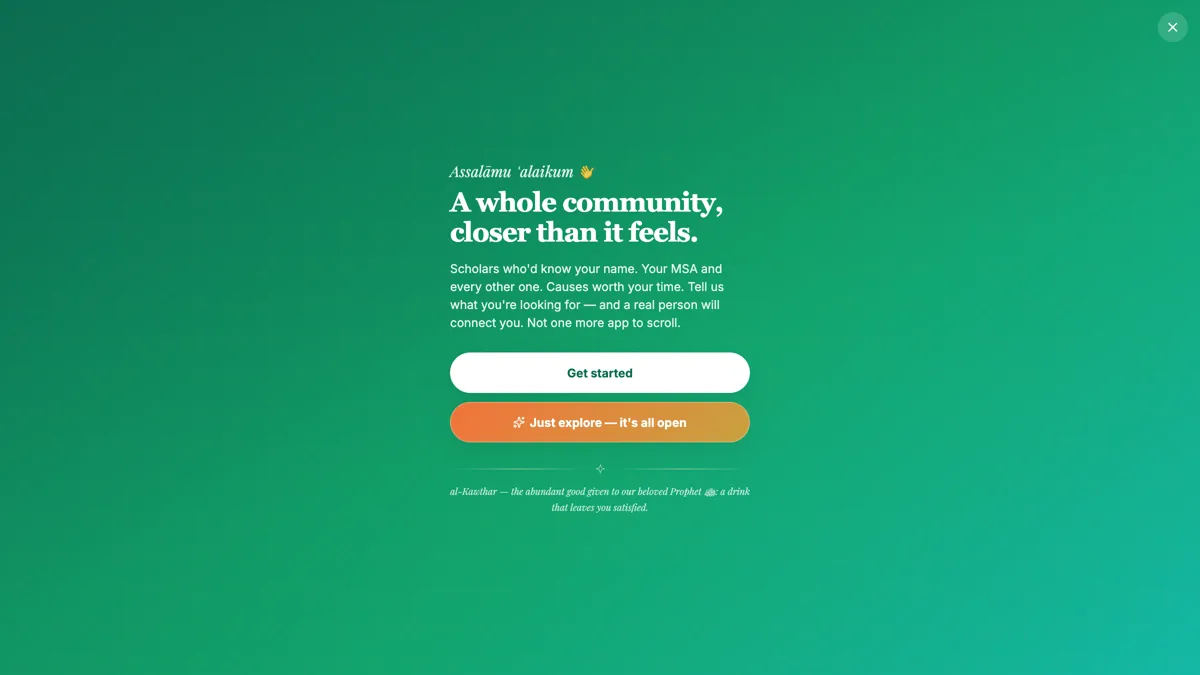
Captured from the live site. Prayer times and mosque data are real, in partnership with Masjidal.
Kawthar is the deep end — a whole platform. Most businesses need something far simpler, and we build those the same way: a clear point of view, real words, and nothing invented to fill space.